
BLOG
Ransomware in Thailand 2026: Why Manufacturers Are the Target
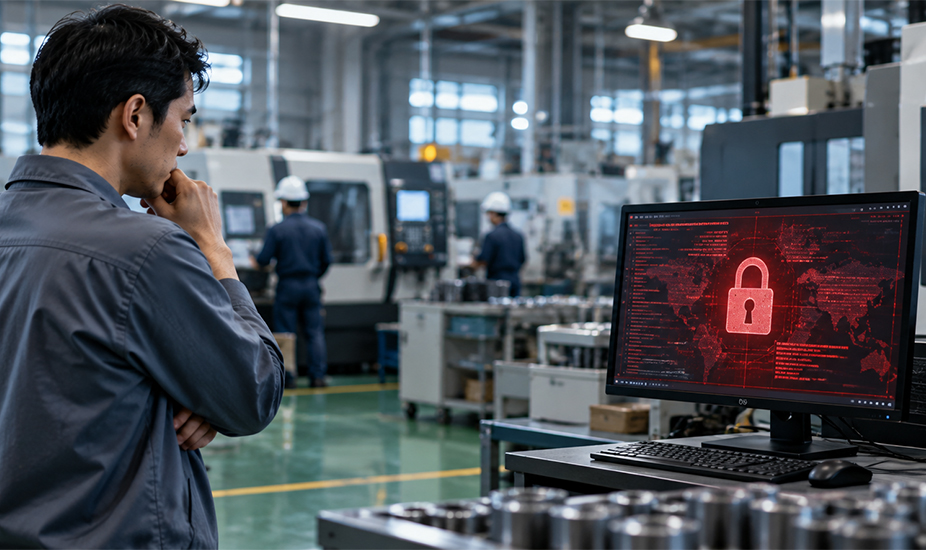
Ransomware in Thailand 2026: Your Factory Is Now the Target
For years, ransomware in Thailand was talked about as a banking and government problem. The 2026 data says otherwise. SOCRadar’s Thailand Threat Landscape Report 2026, published in July, found that manufacturing is now the single most-targeted sector for ransomware in the country, accounting for 37.34% of observed incidents. The report also found the threat is unusually concentrated: one crew, tracked as “The Gentlemen,” was responsible for 42.9% of cases, with much of the remainder spread across smaller, fragmented groups.
If you run a factory, a workshop, an import-export operation or any business with a production or fulfilment line, that statistic is about you. And it is not because attackers admire Thai manufacturing. It is because of a simple economic calculation.
Why attackers prefer factories
Ransomware is a business, and its business model is leverage. A production line that stops on a Friday night is a business that will seriously consider paying by Monday, because every hour of downtime has a cost the owner can calculate to the baht — idle staff, missed shipments, contractual penalties, spoiled stock. That urgency is exactly what the attacker is selling back to you.
Compare that with a business that can absorb a few days offline without existential damage. It is a far less attractive target, because the pressure to pay quickly simply isn’t there. The more your revenue depends on things running now, the more valuable your downtime is to someone who can take it away.
How a ransomware attack actually unfolds
The word “ransomware” suggests a single dramatic event, but a real attack is usually a quiet sequence. It begins with a way in — a phishing email that harvests a password, an exposed remote-desktop port, or an unpatched server found by an automated scan. The attacker then moves through the network slowly, often for days or weeks, mapping what matters and locating the backups.
Modern crews do not just encrypt your files. They copy them first, then encrypt, then threaten to publish. This “double extortion” is deliberate: even a business with perfect backups still faces the prospect of customer data being leaked. And that turns a technical problem into a legal one, because under Thailand’s Personal Data Protection Act (PDPA), leaked personal data is a reportable breach regardless of whether you recover your systems — with a notification clock of 72 hours from discovery.
The backup that isn't a plan
Ask most Thai SME owners how they’d recover from ransomware and the answer is “we have backups.” It is usually false comfort, for three reasons. Backup jobs fail silently, so the copy you’re relying on may be weeks stale or empty. Backups connected to the network get found and encrypted along with everything else — attackers hunt them down first, precisely because they are your escape route. And a backup that has never been restored is a hope, not a plan; the time to discover your restore process is broken is not during an incident.
A real recovery position has two properties most SMEs lack. At least one backup copy is offline or immutable, so it physically cannot be reached and encrypted. And restores are tested on a schedule, so you know — not assume — that you can rebuild yesterday’s data today.
What real protection looks like
You do not need a bank’s security budget to be a poor target rather than an easy one. You need a handful of disciplines running consistently. Continuous monitoring with 24/7 alerting, so the intrusion is caught during the quiet reconnaissance phase rather than discovered on Monday when the files are already locked. A contracted response time measured in hours, not days. Managed backup with scheduled recovery testing and an isolated copy. Multi-factor authentication on every login that touches money or data, which alone stops most password-based intrusions. And disciplined patching, so the vulnerabilities attackers scan for are closed before they’re used.
None of these is exotic. The reason they don’t happen in most Thai SMEs is not cost — it’s ownership. When one person handles finance, HR admin and “the computers,” nobody has time to test restores or chase login alerts, and the gap sits open until something falls into it.
The cost equation
Here is the honest maths. HumanIT’s Gold managed package — the tier most Thai SMEs land on — covers 24/7 SOC-lite monitoring and alerting, a four-hour response, managed backup with recovery testing, and user lifecycle operations, at THB 2,500 per device per month (THB 2,000 on annual billing). Businesses with heavier supply-chain exposure step up to Platinum, which adds full SOC with threat hunting, incident response and forensic support.
A single ransomware incident typically costs a Thai SME far more than a year of coverage — in downtime, lost data, emergency IT fees and customer trust, before any PDPA exposure from leaked data. The gap between what protection costs and what an incident costs is where the whole decision lives.
Frequently asked questions
Is manufacturing really the top ransomware target in Thailand?
According to SOCRadar’s Thailand Threat Landscape Report 2026, manufacturing accounted for 37.34% of observed ransomware incidents — the highest of any sector — driven by the operational cost of downtime in industrial businesses.
If we pay the ransom, do we get our data back?
Sometimes, partially. But payment funds the next attack, offers no guarantee of a working decryption key, and does nothing about data the attacker already copied and may still publish. A tested recovery position is the only defence fully within your control.
How fast do we have to report a ransomware breach in Thailand?
If personal data was exposed — which double-extortion ransomware usually means — the PDPA requires notification to the PDPC without undue delay and, where feasible, within 72 hours of becoming aware of the breach.
What is the single most important thing to fix first?
Make sure at least one backup copy is offline or immutable, and that a restore has actually been tested recently. That is what determines whether ransomware is an inconvenience or a catastrophe.
Worried you couldn’t restore after an attack?
Call Eve on +66 89 354 9916 or see what’s included at humanit.asia/pricing-and-plans.

